To understand how to navigate 2026, we must first brutally analyze why the "set it and forget it" strategies of early 2025 collapsed. The crisis facing AI for lean marketing teams is not about the cost of software; it is about the cost of lost identity.
The Macro Factor: The "Uncanny Valley" of Text
By Q3 2025, consumers developed a heightened "uncanny valley" reflex for text and engagement. Much like we recoil at CGI faces that look almost human but lack a soul, audiences began to subconsciously filter out content that followed the predictable cadence of Large Language Models (LLMs). The "perfect" grammar, the predictable structure, and the lack of distinct opinion became markers of low-value interactions.
This created a paradoxical market demand. As AI content flooded channels, the demand for "vibe marketing," which is content that feels raw, opinionated, and distinctly human, surged to 90% based on internal sentiment analysis trends. Startups that relied on generic prompting saw their Customer Acquisition Costs (CAC) rise, not because their ads weren't running, but because their ads were invisible to an audience inoculated against automation.
The Technical Shift: From Broadcast to Generative Engagement
The response from the technology sector has been a pivot toward hyper-personalization. As noted by WordStream in their December report, the most successful lean teams have moved away from "batch and blast" workflows toward sophisticated, generative engagement tools. These are not systems that simply insert a {First Name} variable. They are dynamic agents capable of interpreting latent sentiment in user behavior and adjusting the tone of the outreach in real-time.
However, this technical advancement cuts both ways. While it allows for deeper connection, it requires a much heavier lift in terms of strategy. You cannot simply plug these tools in; they require a deep reservoir of brand context to function correctly. This is where the enterprise competitors, referenced in guides like those from MoEngage, have an advantage because they have massive data lakes to train these models. Lean startups do not.
The Leadership Gap: The "Chief of Staff" Necessity
This brings us to the operational failure point. Most small marketing teams treated AI as an "Intern," a tool to execute low-level tasks. This was a strategic error. In a lean team, you do not need an intern to write bad copy faster; you need a "Chief of Staff" to manage complexity.
The startups that survived the ROI purge of late 2025 were those that stopped asking AI to "write this blog post" and started asking AI to "analyze our last 50 successful campaigns and outline the tonal patterns that drove conversion." They used the technology to codify institutional knowledge, not just to generate text. They understood that to maintain the "vibe," the AI had to be trained on the company's history, not just the internet's average.
What Will You Learn
- The "Chief of Staff" Framework: This model shows you how to reposition AI from a content generator to a strategic partner that retains institutional knowledge.
- Vibe-Aligned Intelligence: This explains why the "uncanny valley" of text is destroying ROI and how to calibrate your models for human resonance.
- The 6-Month Window: This provides a specific tactical roadmap to stabilize your workflows before late-adopters saturate the market in mid-2026.
- Feedback Loops: This teaches you how to implement "Human-in-the-Loop" verification to ensure every automated interaction feels authentic.
The Chief of Staff Model: From Output to Architect
The emerging pattern for 2026 is the transition from "Automation" to "Augmentation." This distinction is not merely semantic; it is the difference between being ignored and being revered.
The Institutional Knowledge Vault
In a team of three or four people, institutional knowledge is fragile. If your Head of Content leaves, the "voice" of the company often leaves with them. This is where the "Chief of Staff" model revolutionizes lean operations. By treating your AI instance as a repository for brand strategy, campaign history, and voice calibration, you create a layer of continuity that was previously impossible for startups.
I have observed that the most resilient teams now feed their AI every piece of high-performing content, every transcript of a founder's speech, and every customer support win. They are not doing this to generate new content immediately, but to build a "Context Engine." When they eventually do ask for output, the AI is not guessing; it is retrieving from a curated history of the brand's soul.
Vibe-Aligned Intelligence
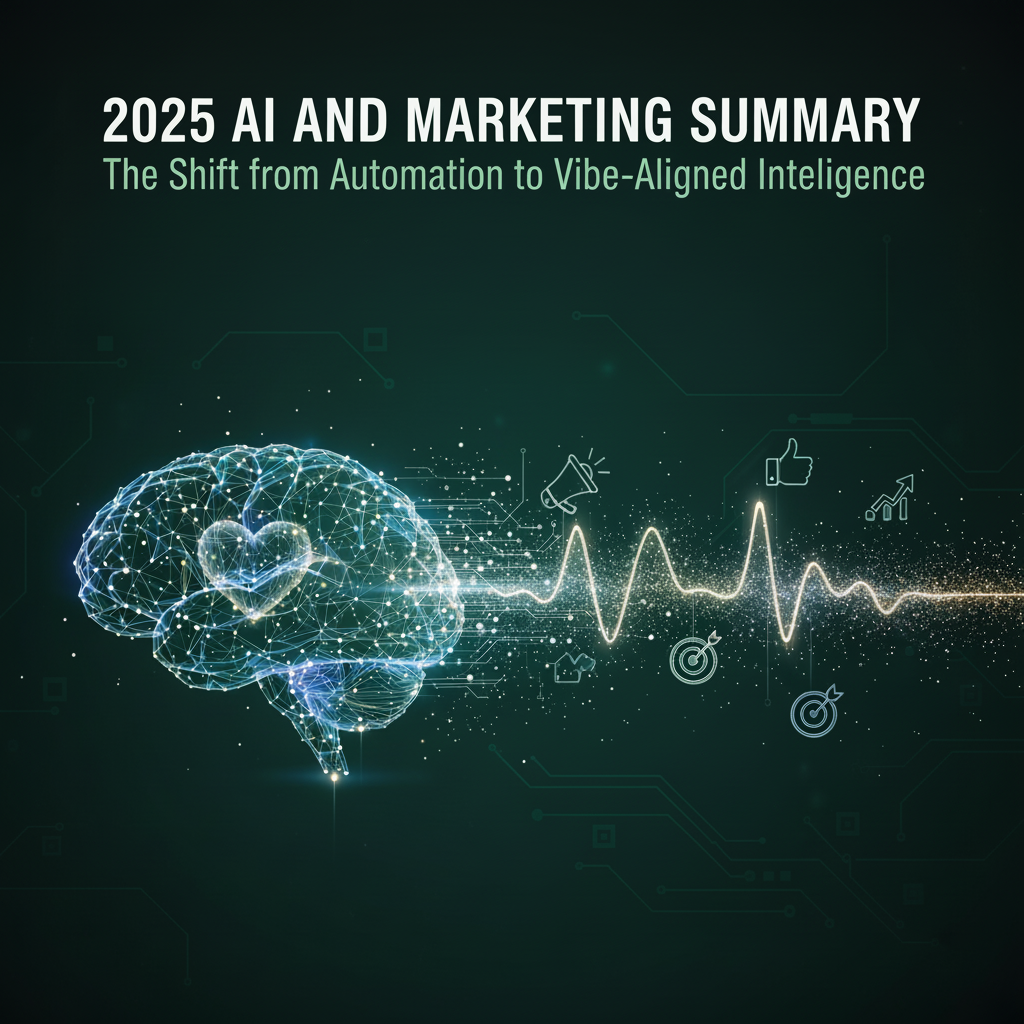
This approach leads to what I call "Vibe-Aligned Intelligence." It is the ability to scale personality. The pattern we are seeing in late 2025 is that "Brand Learning" has become a technical discipline. It is no longer enough to have a brand style guide PDF. You must have a calibrated model that understands the nuance of your brand's humor, the cadence of your skepticism, and the depth of your empathy.
When we look at the difference between a generic startup and a breakout brand in 2025, the differentiator is rarely the product feature set; instead, it is the distinctiveness of the communication. The "Chief of Staff" model ensures that distinctiveness is not diluted by scale. It allows the marketing leader to act as an Architect rather than a Bricklayer. The AI lays the bricks, but only according to the hyper-specific blueprint derived from the brand’s own history.
Visualizing the Workflow: The Context Engine
To illustrate how this shifts the daily operation of a marketing leader, consider the "Chief of Staff" workflow in which AI serves as a filter and context engine rather than just a generator. Raw inputs like market data and briefs feed into the AI Chief of Staff, which retrieves brand history, calibrates tone and vibe, and drafts options. The human architect then performs verification and nuance injection to ensure authenticity.
Calibrating for 2026: A Tactical Roadmap
We have a shrinking six-month competitive window. By mid-2026, the late majority will have figured out calibration, and the playing field will equalize again. To maximize the current advantage, marketing leaders must implement these specific protocols immediately.
1. The Human-in-the-Loop Verification Cycle
This involves a mandatory operational step where a senior team member reviews AI output not for accuracy, but for "vibe." This is vital because GoHighLevel’s analysis of automation trends highlights that while automation handles the mechanics, the failure point is almost always in the emotional resonance. This ultimately prevents brand erosion. One robotic email can cause a permanent unsubscribe. The Human Architect must inject the 10% of chaos, humor, or empathy that the model statistically smooths out.
2. Operationalize "Brand Learning" Sessions
CMOs and Heads of Brand should spend one hour weekly feeding their "Chief of Staff" with their best and worst recent interactions. Explain why the win was a win and why the loss was a loss. This creates a feedback loop where the AI gets smarter about your specific company culture, effectively onboarding it deeper into your organization every week. This transforms the AI from a generalist tool into a proprietary asset.
3. Shift Metrics from Volume to Resonance
For this step, stop measuring "blogs published" or "emails sent" and start measuring "replies per 1,000 sends" and "time on page." In a saturated market, attention is the only currency. High volume with low resonance is actually negative equity since it trains your audience to ignore you. Focusing on resonance forces the team to use AI for quality enhancement, such as research, structure, and counter-arguments, rather than just bulk text generation.
The Authenticity Mandate: A Vision for the Future
As we look toward 2026, the question is no longer "How much can we automate?" but "How much should we authenticate?" The 2025 AI and marketing summary is clear. We have reached the ceiling of what raw efficiency can deliver. The 88% adoption baseline means that being fast is no longer special. The winners of the next cycle will not be the ones who build the biggest factories, but the ones who run the most disciplined studios.
I challenge you to decide if you are using AI to replace your humanity or if you are using it to clear the clutter so your humanity can shine brighter. The tools are ready to serve as your Chief of Staff, but they cannot be your soul. That responsibility remains, as it always has, with you.
Key Takeaways
- Adoption is Ubiquitous. With 88% of companies using AI, efficiency is now a commodity, not a competitive advantage.
- The Vibe Shift. 2026 will be defined by "Vibe-Aligned Intelligence," which is the ability to use AI to scale authentic, brand-specific personality rather than generic text.
- Chief of Staff Model. Small teams must treat AI as a repository for institutional knowledge, or a "Context Engine," rather than just a content generator.
- Urgency. There is a six-month window to master "Brand Learning" before the market fully saturates with calibrated models.
- Metric Pivot. Shift KPIs from output volume to engagement resonance to survive the "uncanny valley" of automated content.